

ABH: 70.203
BF: 1661
Family: Geometridae
Subfamily: Archiearinae
Taxon: Archiearis parthenias
Authority: (Linnaeus, 1761)
Vernacular: Orange Underwing

Account: Local in open woodland, scrubby heathland, embankments, and other rough open ground throughout much of the British Isles A diurnal flyer, seen in warm spring sunshine, often high amongst the branches but occasionally seen well on the ground - it seems to have an attraction to horse dung. They should be netted for examination: those netted are invariably males. Very similar to Light Orange Underwing B. notha, males can be distinguished by their antennae which are finely serrated in Orange Underwing, and are slightly feathered in Light Orange Underwing; on underside of hindwing of Orange Underwing, orange band projects centrally into dark outer band, often reaching outer margin, while in Light Orange Underwing, dark outer band is unbroken, and central projection of orange band is absent (MBGBI Vol 7 part 2). Larva feeds on Downy and Silver Birch, over-wintering as a pupa.
Wingspan: 35 — 39 mm
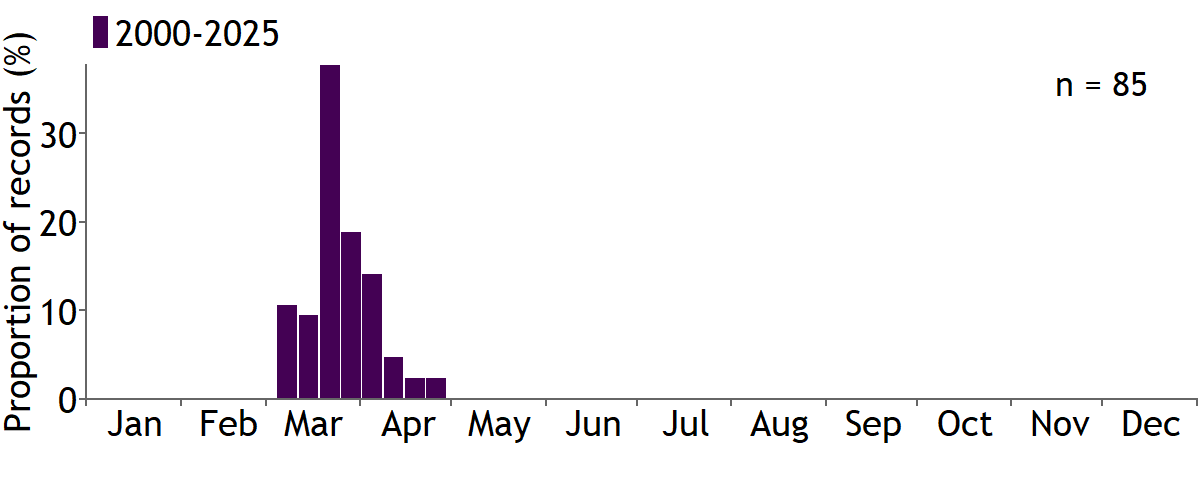
Surrey Flight Period: 4 Mar (1967) — 30 Apr (1986)
Foodplant: Betula sp. (a birch), Sorbus aucuparia (Rowan).
Status: Least Concern (LC)
UK BAP:
WCA:
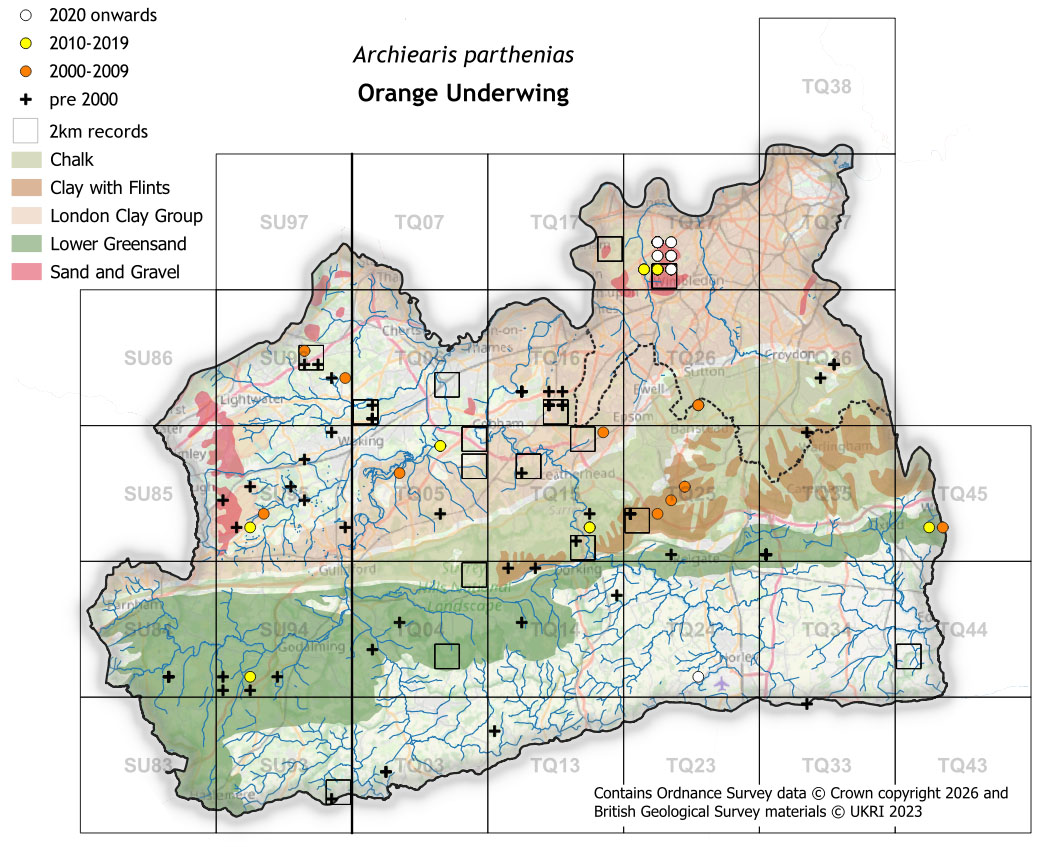
Click here to view the full geology map of Surrey.
Verification Grade: 2 — Care needed to identify, an image may be required 🤔
Further Information: https://www.ukmoths.org.uk/species/archiearis-parthenias/
* Based on adult records only.
Records: 187
Individuals: 238
Earliest Year: 1895
Latest Year: 2025