

ABH: 15.008
BF: 286
Family: Gracillariidae
Subfamily: Gracillariinae
Taxon: Caloptilia alchimiella
Authority: (Scopoli, 1763)
Vernacular: Oak Stilt

Account: In Hampshire and on the Isle of Wight probably markedly less common than C. robustella, although the true distribution of records historically is unknowable due to many records not being supported by critically examined specimens: C. alchimiella was only separated from robustella in 1972 and for many years, with reference to Heath & Emmet (1985) : 'The Moths and Butterflies of Great Britain and Ireland, Vol. 2', the two species could be differentiated externally by a number of characteristics:
- apex in C. alchimiella purplish-brown, darker than the thorax; in C. robustella yellowish like the thorax.
- thorax in C. alchimiella golden-yellow with pale purple-brown tegulae; in C. robustella yellowish with similarly colored tegulae.
- forewing in C. alchimiella with sharply defined basal spot; in C. robustella diffusely defined.
- outer border of the costal spot in C. alchimiella extending almost to the apex; in C. robustella it meets the costa steeply at about five-eighths.
- small yellow spot on the tornus (inner angle) present in C. alchimiella, absent in C. robustella.
Plant (2023) draws attention to the great rarity of this species in southern England in recent years. Many specimens that were initially identified as C. alchimiella from external features were re-determined as C. robustella upon dissection, suggesting that these previously used differences in external appearance may be unreliable. Therefore, while the above features can be used to provide an initial indication to species, they are not reliable for certain identification.
Wingspan 10-13 mm. As above, easily confused with C. alchimiella, from which it can only safely be separated by dissection of the genitalia; both feed on oak, but C. alchimiella is probably univoltine with a protracted emergence period, while C. robustella is bivoltine. Larva mines leaves of Oak, subsequently living within a leaf-fold, over-wintering as a pupa: the larva and leaf mines cannot be distinguished from those of C. robustella.
Ref: Plant, C.W., 2023. Whatever happened to Caloptilia alchimiella? The Entomologist’s Record andJournal of Variation 135: 63-64.
Wingspan: 10 — 13 mm
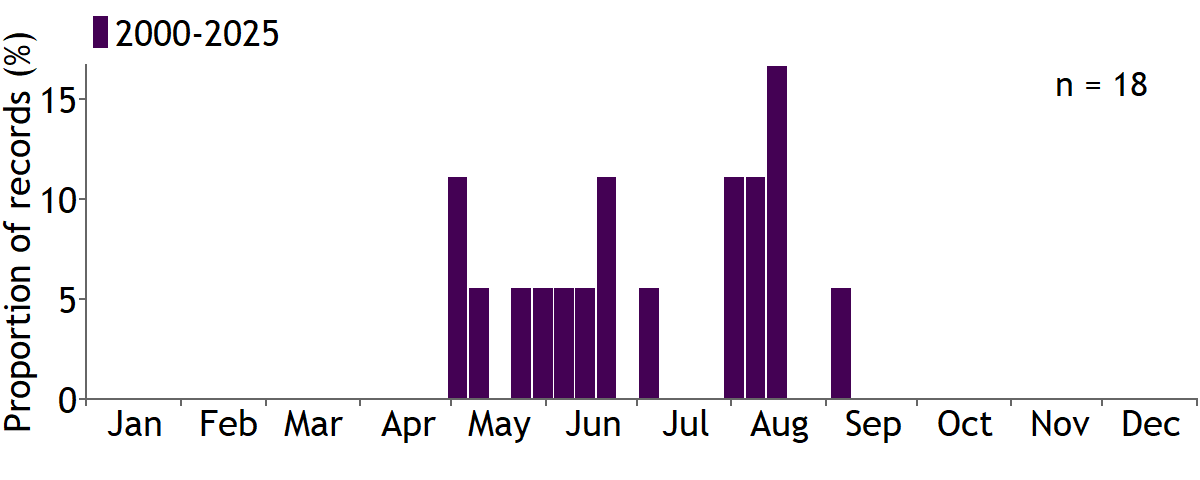
Surrey Flight Period: 30 Apr (2011) — 5 Sep (2012)
Foodplant: Quercus petraea (Sessile Oak), Quercus robur (Pedunculate Oak), Quercus sp. (an oak).
Status: Common
UK BAP:
WCA:
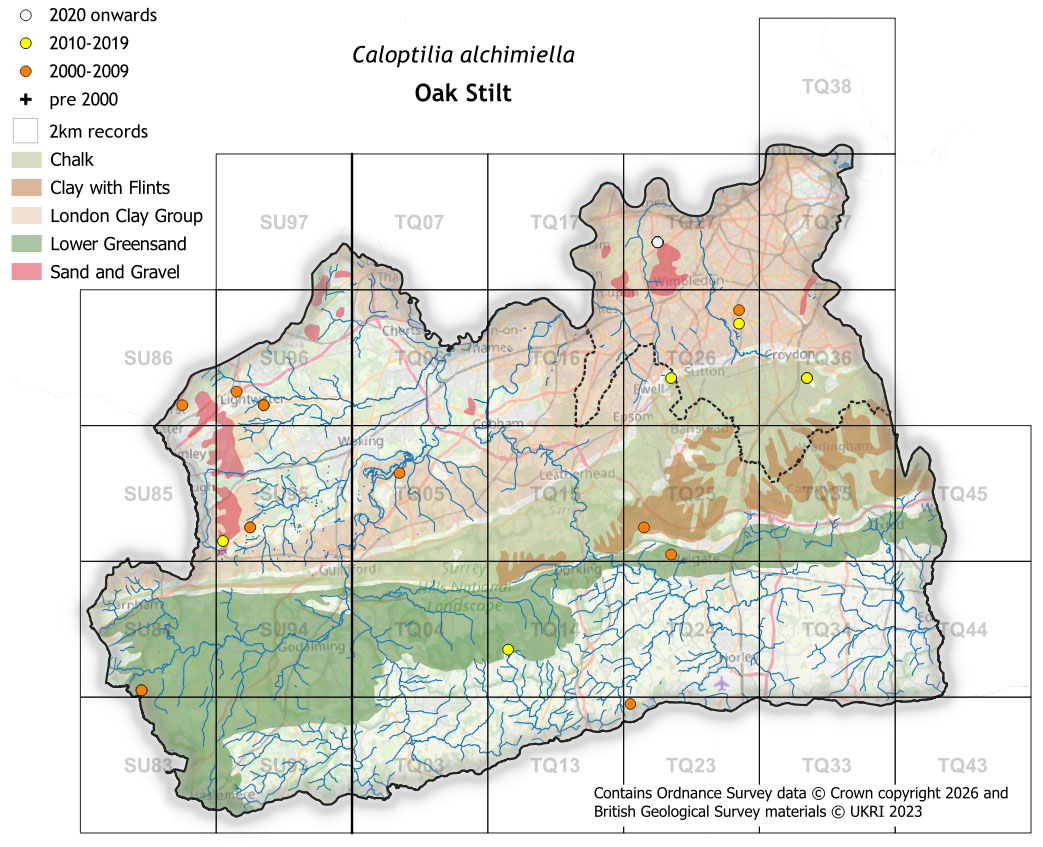
Click here to view the full geology map of Surrey.
Verification Grade: 4 — ️‼️Dissection required️‼️
Further Information: https://www.ukmoths.org.uk/species/caloptilia-alchimiella/
* Based on adult records only.
Records: 25
Individuals: 7
Earliest Year: 2000
Latest Year: 2025