

ABH: 21.002
BF: 262
Family: Lyonetiidae
Subfamily: Lyonetiinae
Taxon: Lyonetia prunifoliella
Authority: (Hübner, 1796)
Vernacular: Blackthorn Blister Moth

Account: Formerly reported from the Midlands at Boughton, Worcestershire, Whittlebury Forest, Northamptonshire and near Stony Stratford, Buckinghamshire, and also from Worthing, Sussex, and it was fairly common in the late 19th Century (MBGBI Vol 2), it was not seen in the 1900's and was assumed to have become extinct. The first recent record appears to be in 2007, since when it has been encountered with increasing frequency in a number of counties including Dorset and Norfolk, perhaps following re-colonisation from the continent; the first Hampshire record was in 2014, since when it has been encountered with increasing regularity on the coast of Hampshire from Portsmouth to Hayling and on the south-eastern side of the Isle of Wight. The first North Hampshire record came in 2021, with another in 2023, and it will likely become more frequent inland. Wingspan 9-10 mm. The larva mines the leaves of various roseaceous trees, such as Blackthorn and apple, forming a gallery leading to a blotch. The pupal cocoon is suspended from silken 'guyropes' and closely resembles that of L. clerkella.
Wingspan: 9 — 10 mm
Surrey Flight Period: —
Foodplant: Prunus spinosa (Blackthorn), Rosaceae.
Status: pRDB1
UK BAP:
WCA:
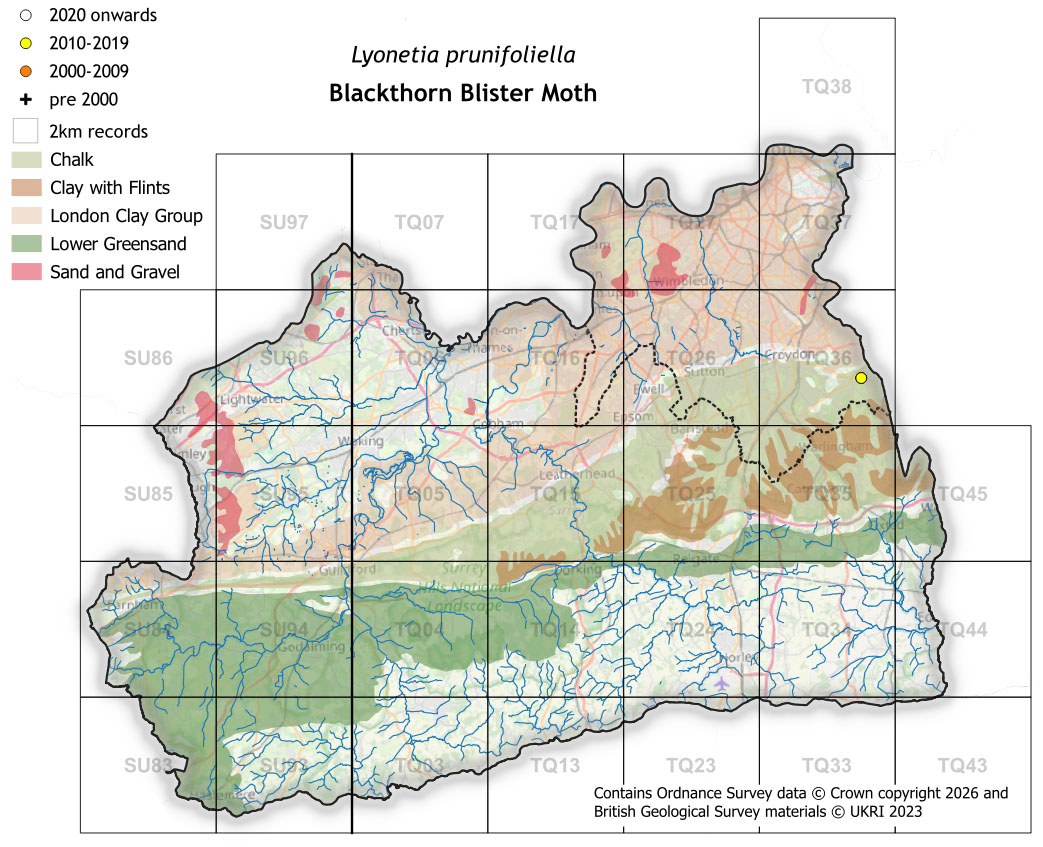
Click here to view the full geology map of Surrey.
Verification Grade: 3 — Difficult to identify, an image may be required 🤔🤔
Further Information: https://www.ukmoths.org.uk/species/lyonetia-prunifoliella/
* Based on adult records only.
Records: 1
Individuals: 0
Earliest Year: 2017
Latest Year: 2017